Small nutrients.
Everyday difference.

Vitamins and minerals are needed in tiny amounts, yet they quietly support nearly everything your body does. Learn how food, daily habits, and — when appropriate — responsible supplementation fit together, then talk it through with a real person.

Free 30-minute video call. No pressure, no obligation, and nothing to buy to take part.

  • Education before promotion
  • Food-first, supplement-second
  • Works alongside your healthcare provider
  • No health claims, no pressure

Food first

Your daily check-in

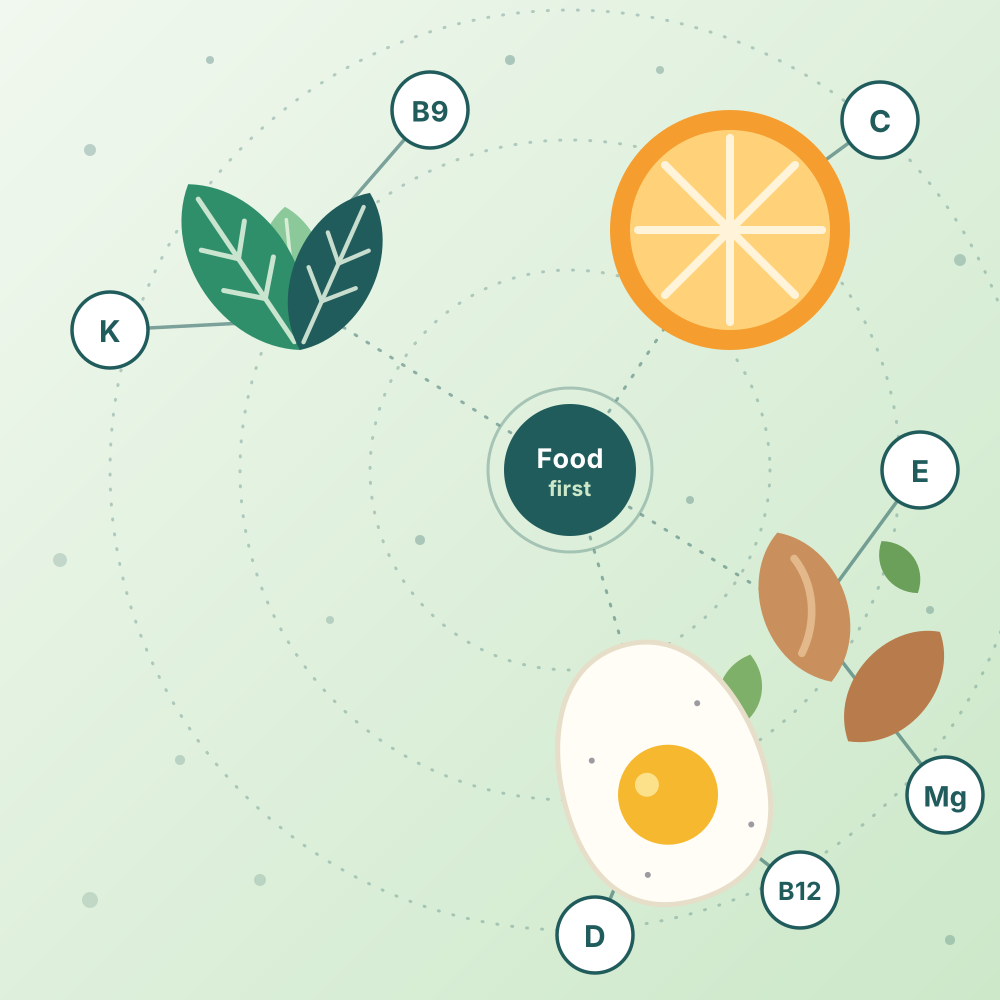
  • Leafy greensFolate, vitamin K
  • Citrus & berriesVitamin C
  • Nuts & seedsMagnesium, vitamin E
  • Eggs & fishVitamin B12, vitamin D
Illustration of leafy greens, a citrus slice, nuts and a boiled egg, each linked to the nutrients it provides, such as vitamins K, C, E, B12 and D, and magnesium

What are micronutrients?

Short answer

Micronutrients are the vitamins and minerals your body needs in small amounts to work normally. Unlike macronutrients — protein, carbohydrate, and fat, which supply energy — micronutrients supply no calories. They act as the helpers behind everyday processes: turning food into energy, building and repairing tissue, supporting normal immune function, and keeping bones, blood, nerves, and hormones working as they should.

Vitamins

Organic compounds your body mostly cannot make on its own. Water-soluble vitamins such as vitamin C and the B group are not stored in large amounts, so they are typically needed regularly. Fat-soluble vitamins — A, D, E, and K — are absorbed with dietary fat and stored in body tissue.

Minerals

Inorganic elements that come from soil and water and reach us through food. Major minerals such as calcium, magnesium, and potassium are needed in larger amounts. Trace minerals such as iron, zinc, iodine, and selenium are needed in far smaller amounts — but they still matter.

Why "micro"?

The prefix describes quantity, not importance. Many micronutrients are measured in milligrams or micrograms per day — fractions of a gram. Small amounts, consistently supplied, are what the body is looking for. More is not automatically better, and some nutrients have upper limits worth respecting.

Why do micronutrients matter?

Because they participate in the ordinary work your body does every hour — energy release, repair, defense, and signaling.

Short answer

Micronutrients matter because most of the body's chemistry depends on them. Enzymes need mineral partners to function, red blood cells need iron and B vitamins to carry oxygen, bones need calcium and vitamin D to stay dense, and the immune system draws on zinc, vitamin C, and vitamin D to work normally. When intake is consistently low over time, those ordinary processes have less to work with.

Vitamin D

VitaminBone & immune support

Helps the body absorb calcium and contributes to normal immune function. Skin makes it from sunlight, which is why intake varies with season, latitude, skin tone, and time spent indoors.

Food sources: fatty fish, egg yolks, fortified milk and cereals.

Magnesium

MineralEnergy & muscle function

Involved in hundreds of enzyme reactions, including those that release energy from food and support normal muscle and nerve function.

Food sources: leafy greens, pumpkin seeds, almonds, black beans, whole grains.

Iron

MineralOxygen transport

A core part of hemoglobin, the protein that carries oxygen in the blood. Needs differ notably by age, sex, and life stage.

Food sources: lean red meat, lentils, tofu, spinach, fortified grains.

Vitamin B12

VitaminNerves & blood cells

Supports normal red blood cell formation and nervous system function. It occurs naturally in animal foods, so plant-based eaters often look to fortified foods.

Food sources: fish, meat, dairy, eggs, fortified nutritional yeast.

Calcium

MineralBone structure

The main structural mineral in bones and teeth, and also involved in normal muscle contraction and nerve signaling.

Food sources: dairy, fortified plant milks, canned sardines, kale, tofu set with calcium.

Zinc

MineralImmune & repair

Contributes to normal immune function, wound healing, and the sense of taste and smell. The body has no large storage reserve.

Food sources: oysters, beef, chickpeas, cashews, seeds.

Potassium

MineralFluid & blood pressure balance

An electrolyte that helps maintain normal fluid balance and supports normal blood pressure as part of an overall dietary pattern.

Food sources: potatoes, beans, bananas, yogurt, tomatoes, avocado.

Folate

VitaminCell growth

Needed for normal cell division and the formation of DNA. Requirements rise notably before and during pregnancy.

Food sources: lentils, asparagus, leafy greens, oranges, enriched grains.

These summaries describe the general roles nutrients play in normal body function. They are educational and are not a claim that any food or supplement treats, prevents, or improves a medical condition.

Where do nutritional gaps come from?

Short answer

A nutritional gap simply means that usual intake of one or more nutrients falls below what a person's body is looking for. Gaps are rarely dramatic and rarely deliberate. They usually build slowly out of ordinary life — busy schedules, narrow food routines, restricted eating patterns, changing needs across the lifespan, or differences in how well the body absorbs a nutrient.

Everyday routines

Meals eaten quickly, repeated food choices week after week, or long stretches of convenience eating can narrow the variety of nutrients coming in — even when total calories are more than adequate.

Eating patterns

Plant-based, dairy-free, low-carbohydrate, and other intentional patterns can all be nourishing. Each one simply asks for attention to the nutrients that pattern naturally supplies less of.

Life stage

Needs shift with age, activity, pregnancy and nursing, and later adulthood. What was plenty at twenty-five is not automatically plenty at fifty-five.

Absorption

Certain digestive conditions, some medications, and normal age-related changes can affect how much of a nutrient the body actually takes up from food. This is a question for your healthcare provider.

Demand

Heavy training, physical work, high stress periods, and recovery can increase what the body draws on — and increase how much attention nutrition deserves.

Food supply variability

Growing conditions, storage time, and preparation methods all influence the nutrient content of what ends up on the plate. Two similar-looking meals are not always nutritionally identical.

How gaps are actually identified

Only a qualified healthcare professional can determine whether you have a nutrient deficiency. That normally involves a review of your health history and, where appropriate, laboratory testing. This website does not diagnose deficiencies, and we do not ask you for diagnoses, medications, or medical history.

Food comes first — always

Whole foods deliver nutrients in combinations that are difficult to reproduce in any other form: vitamins and minerals alongside fiber, protein, healthy fats, and the many plant compounds that come with them. Those components work together, and that is a genuine advantage of eating well.

A food-first approach does not require perfection or an expensive shopping list. It usually looks like a handful of steady, repeatable habits.

  • Add color. Different pigments tend to travel with different nutrients — aim for variety across a week, not a single perfect plate.
  • Favor whole over refined. Whole grains, beans, nuts, and seeds carry more of their original micronutrient content.
  • Build around protein and produce. A simple, reliable template for most meals.
  • Keep good options easy. Frozen vegetables, canned beans and fish, and pre-washed greens all count.
  • Notice the pattern, not the day. Nutrition is cumulative. One meal rarely decides anything.
Talk through your everyday eating
Overhead view of whole foods on a wooden table: leafy greens, carrots, red peppers, tomatoes, a bowl of chickpeas, eggs, nuts and seeds, and a halved lemon

When might supplementation be considered?

Short answer

Supplements are intended to supplement a diet, not to replace one. They may be worth discussing with a qualified healthcare professional when usual food intake consistently falls short of a person's needs, when an eating pattern naturally supplies less of a particular nutrient, when life stage or absorption changes what the body requires, or when a provider has identified a specific need. The decision belongs with you and your provider — not with a website.

What a supplement can reasonably do

  • Contribute nutrients that a person's usual diet supplies in smaller amounts
  • Add consistency when eating patterns vary week to week
  • Support a nutrient need a healthcare professional has identified
  • Complement — never replace — an overall nutritious eating pattern

What a supplement cannot do

  • Diagnose, treat, cure, or prevent any disease or medical condition
  • Replace prescribed medication, medical care, or professional advice
  • Substitute for a varied diet, sleep, movement, or stress management
  • Guarantee any particular result — individual responses differ

Questions worth asking about any supplement

  • What specific need would this address for me, and how was that need identified?
  • What is actually in it — which nutrients, in what forms, and at what amounts?
  • How does the amount compare with established daily intake references and upper limits?
  • Is the product independently tested for quality and content accuracy?
  • Could it interact with a medication I take or a condition I have? (Ask your pharmacist or physician.)
  • Does it fit my routine well enough that I would actually take it consistently?

Why individual needs differ

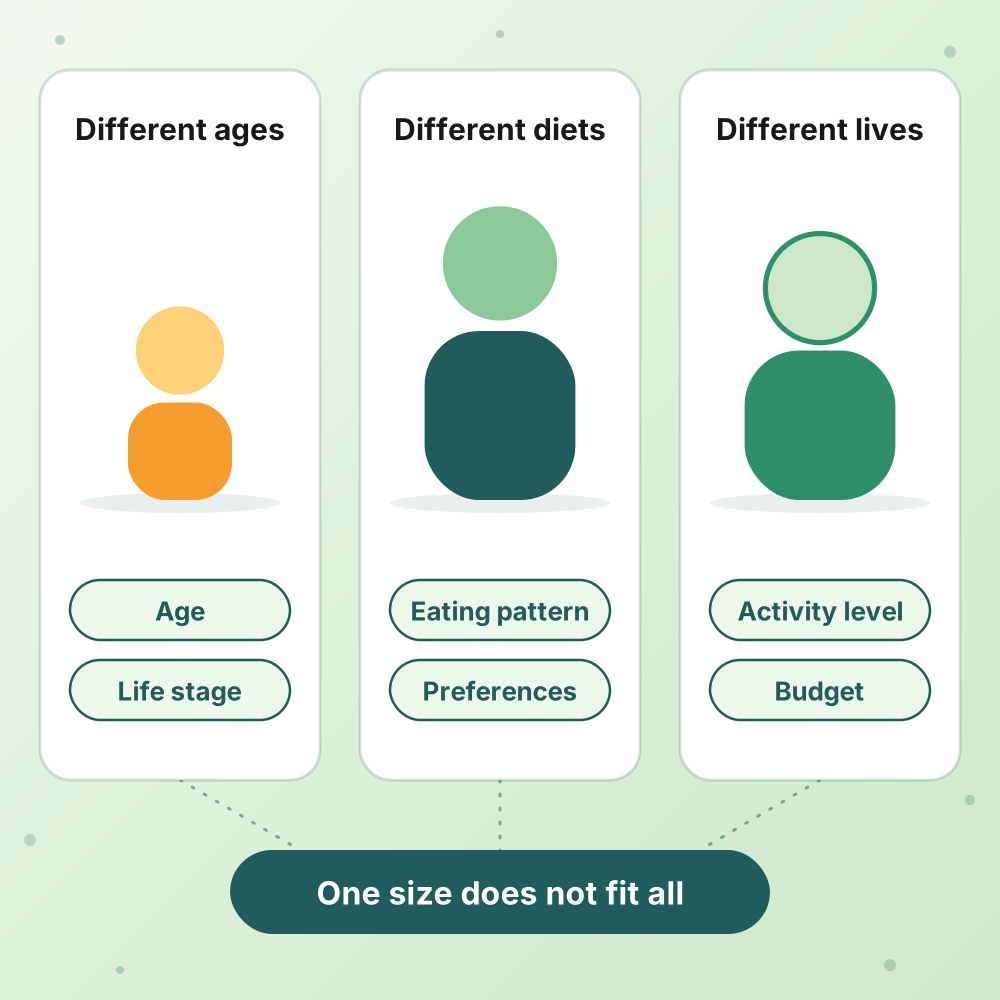
There is no single nutrient plan that fits everyone. Age, sex, body size, activity level, life stage, eating pattern, medications, absorption, budget, culture, and plain personal preference all shape what "eating well" looks like for one specific person.

That is exactly why we offer a conversation rather than a checklist. A short, free video call gives us the chance to understand your situation, answer your questions in plain language, and point you toward next steps that make sense for you — including, when it is the right answer, simply talking to your doctor.

Book an appointment
Illustration of three people of different sizes in cards titled Different ages, Different diets and Different lives. Each card lists two factors that shape what a person needs: age and life stage, eating pattern and preferences, activity level and budget. A banner below reads: One size does not fit all.

Book a time

Choose what you would like to talk about, share your contact details, and pick a date and time that suits you.

Get your details

You will receive an email confirmation with your video link and a calendar invitation, plus a reminder before the call.

Have the conversation

About 30 minutes on a video call. We listen, answer your questions, and share educational information — no pressure and no obligation.

Decide what is next

Learn more, explore the product, look at the business opportunity, talk to your healthcare provider, or simply leave with better information.

What would you like to talk about?

Pick whichever fits. It only sets where the conversation starts — you can change your mind on the call.

The product

Understand what responsible supplementation looks like, and whether it belongs in your routine. How it is formulated, how it fits a food-first approach, what quality testing means, and honest answers about what it will and will not do.

Choose this

The opportunity

How the independent affiliate side actually works: what the commitment involves, the training and support available, and clear expectations — this is not employment, and earnings are not guaranteed.

Choose this

Both

Everything in the two above, plus how personal use and the business fit together, what a realistic first ninety days looks like, and time to ask whatever you actually want to ask.

Choose this

Every option is the same free 30-minute video call. Nothing to buy, no obligation.

The specific product is introduced during your consultation rather than promoted here, so the conversation can start with your situation instead of a sales pitch. Read our affiliate and business opportunity disclosure.

Frequently asked questions

Yes. The consultation is completely free, lasts about thirty minutes, and takes place by video call. There is nothing to buy in order to book one, and you are under no obligation afterward.

Not at all. Most people book because they want to understand their nutrition better. When you schedule, you choose whether you want to talk about the product, the business opportunity, or both — and the conversation follows what you selected.

No, and we will never suggest otherwise. Dietary supplements are not intended to diagnose, treat, cure, or prevent any disease. If you are managing a health condition, your physician and care team remain in charge of your treatment. What we can talk about is how balanced nutrition and appropriate supplementation may support overall wellness alongside their guidance.

Because we would rather start with your situation than with a product page. The specific supplement is introduced during the consultation, once we understand what you are actually looking for and whether it is even relevant to you.

Bring your questions. We will bring plain answers.

A free 30-minute video call about micronutrients, everyday nutrition, and what might make sense for you.

Educational information only. Not medical advice. Please consult a qualified healthcare professional before changing your diet, supplements, or treatment.